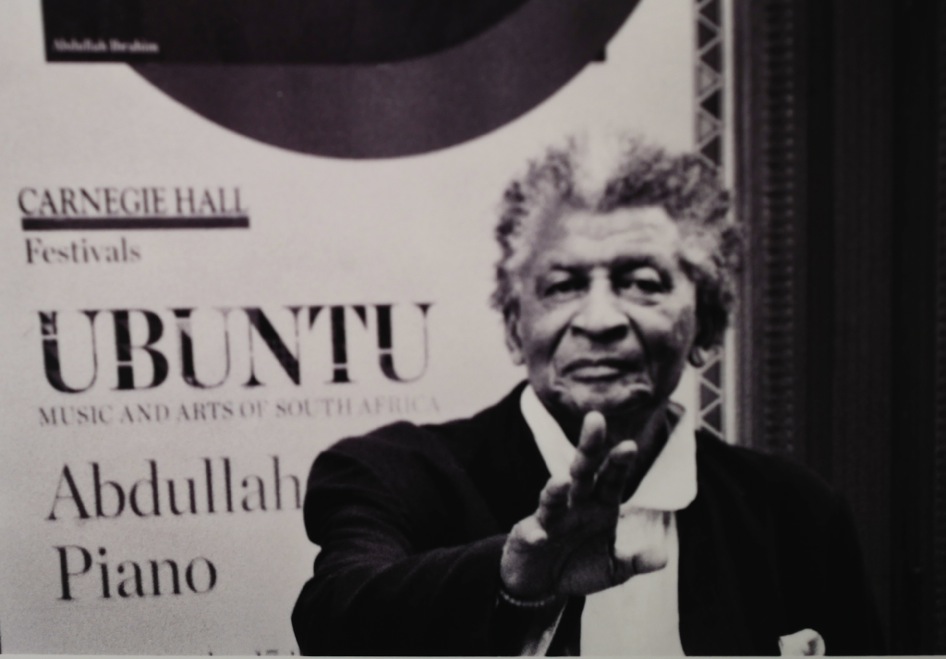
Sawubona.
For me to begin this, I would have to start at the beginning. Most of the things that have the greatest impact in my life, usually introduce themselves, rather than through someone else.
Let me take you back to my maternal grandparents’ home, kwaMthethwa. Home where the FM was almost always on, playing Ukhozi FM. Outside the house, there was a place where we would gather during sunset, we called it esithangamendlu. We would stand leaning on the wall, and soak in the left over warmth of the sun.
I don’t remember on which days, but I remember that it was more than once. There were particular days, where the FM would play this song which seemed to have no beginning or end. Oh my, the piano was something you would hear at the end of this world. It’s was Mkhulu Abdullah Ibrahim’s Blues For A Hip King.
It would take a lot of years, growing and music digging for me to come back to home to South African Jazz as a sound of choice –with Blues For A Hip King as favourite for years and years to come. But not matter how many years, men and women will pass, there will always be music that makes me believe germs don’t exist.
Mannenberg(1974), The Unofficial National Anthem of South Africa
Countries and times, have been blessed with an official, and unofficial national anthem. The former, is how the state would like to see things. The latter, is how things are. In most cases, the unofficial, is usually the official one.
Official in a sense that it’s the people, and not the “officials” that choose it.
About the classic, mnumzane Ibrahim said, “…Basil was from Manenberg and for us Manenberg was just symbolic of the removal out of District Six, which is actually the removal of everybody from everywhere in the world…” the mnumzane Basil Coetzee mentioned, was a saxophonist who played on the song, and was also later called, “Manenberg”.
Initially, mnumzane Ibrahim wanted to name the song Mrs. Williams from Manenberg, but the producer, mnumzane Rashid Vally, founder of the legendary As Shams/The Sun Records, marketed it as just Mannenberg – Is Where It’s Happening. Adding an extra “n” on Manenberg.
The “Mrs. Williams” that was initially suggested, was in reference to a Mrs. Gladys Williams, who was the housekeeper for saxophonist, mnumzane Morris Goldberg’s parents. What’s the connection?
Well mnumzane Ibrahim, has mentioned that some of his music, comes from dreams and visions that he often had. And for the work around that particular time, he had a vision of an old woman walking down the township street.
To fulfil the vision, the pianist took a photograph of her, in form of Mrs. Gladys Williams, who is the one we see on the cover of the record.
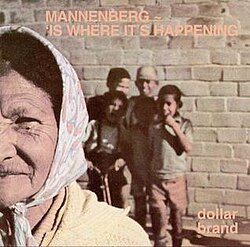
Before the record was even released, people were already requesting it from mnumzane Rashid Vally when they heard him blasting it at his shop Kohinoor.
When it was eventually released, the record sold 5,000 copies in it’s first week, right of the counter of Kohinoor. After signing a distribution deal with the legendary label, Gallo Records, it sold more than 40, 000 copies in less than a year. Around the time, 20, 000 copies in sales was the benchmark at the time.
A defying of odds that mnumzane Ibrahim saw as, “an affirmation that our inherent culture is valid”. The success was not only on sales, but in touching the consciousness of the people too.
An unofficial anthem for the liberation movements, as it was also “whistled by comrades in prison cells reaching out to one another”.
“When we listened back to it,” mnumzane Ibrahim has said, “we realized that we’d done what we’d been trying to do for a long time: we’d captured the essence of the people.”
Mannenberg, Playing at a Mayoral Inauguration in New York City
“Mannenberg” was played at mnumzane Zohran Mamdani’s inauguration as mayor of New York City in January 2026.
Recalling the significance of the moment, writer mnumzane Bongani Madondo who attended the event, wrote an article called How ‘Mannenberg’ Took Manhattan.
“Amid the proceedings”, Madondo wrote, “was a three-minute, you-snooze-you-lose moment. Just as the poet Cornelius Eady was invited to the podium to read the poem he had written for the occasion, the strains of Abdullah Ibrahim’s Mannenberg were heard.” The music was coming from a speaker somewhere.
A moment that uncannily resembled another significant one. It’s said that when utata Nelson Mandela was imprisoned in Robben Island, was the first time he heard the song. It happened that somehow, someone smuggled a copy of the record inside the prison, and it was played on speakers, where tata was able to hear it. And the song is reported as one that gave him hope that, “Liberation is near”.
An interesting irony, is that the song ends with the old man saying, “Julle kan ma New York toe gaan, ek bly in die Manenberg” [Y’all can go to New York, I live in Manenberg]. The lo and behold, he is inaugurating a mayor in New York.
What Is South Africa’s Current Unofficial Anthem?
The “unofficial anthem” of a country, says a lot about that country’s values, state and collective consciousness. It says a lot about where they seem to be going.
Mannenberg being released in 1974, we saw what action that decade gave birth to. An impact that is still positively shaking us five decades later. Some living today, their very existence is an act of…how can I put it?
Have you noticed how many Rastas and monks are such peaceful people, but whenever they walk into a room, you know they mean war, burning and gnashing of teeth.
The current question is, what is this generation’s unofficial anthem? Some jokingly (or not), say it’s the brother Mgarimbe’s Sister Bethina? Should we go there? Or am I being a party pooper?
Similarities between Mannenberg and Sister Bethina
The originals of these songs, are both improvisations/freestyle. Both were recorded in one take. Both of the originals, are very long –more than 10 minutes each.
But that is just about the only similarities they have. I’m sure this is something none of the artists involved asked for, they were just making music. Then our collective shandis picked it up, and revealed to us what we’ve become.
Farewell
Final words to Dr. Abdullah Ibrahim, as you face the sun, may Blues For A Hip King keep you company. Peace be upon you.